


Imagine steering a massive commercial vehicle that suddenly hits an unexpected corporate roadblock. Under the old regulations, you had to wait indefinitely for clearances, allowing the vehicle’s valuable cargo to slowly spoil. Under the newly enacted Insolvency and Bankruptcy Code (Amendment) Act monitored by the Insolvency and Bankruptcy Board of India (IBBI), the entire process changes. The legal framework now treats corporate financial distress like an emergency pitstop: the primary goal is a swift fix to keep the business moving, preserving its core asset value.
India’s new IBC law introduces game-changing adjustments to structural procedures, judicial timelines, and creditor hierarchies. Let’s break down the 5 major shifts in India’s new IBC law that are fundamentally altering how businesses operate, borrow, and restructure.
1. Eliminating Delays: Strict Timelines for the NCLT
In previous years, the statutory 14-day window for the National Company Law Tribunal (NCLT) to admit or reject an insolvency application was often treated as a flexible guideline. Cases frequently remained stuck at the admission stage for months due to extensive debates over non-essential factors.
India’s new IBC law tightens these procedural requirements to eliminate backlogs:
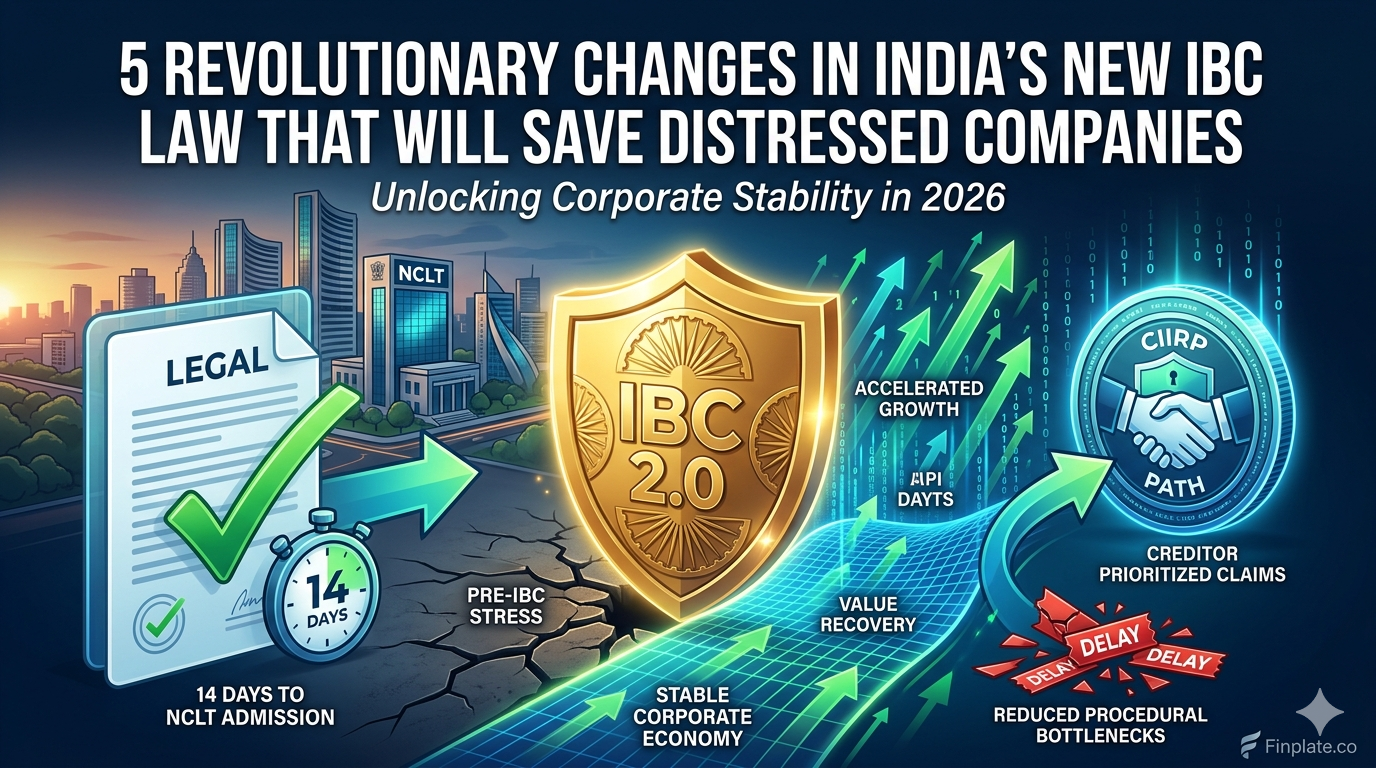
- Mandatory 14-Day Admission: The NCLT must admit a case within 14 days once a debt default is established and basic compliance is met. Extraneous arguments can no longer be used to delay the initiation process.
- Two-Stage Resolution Approvals: Previously, resolution plans were frequently delayed if the proposed distribution of funds among creditors was contested. Under India’s new IBC law, a dual-track process is permitted: the NCLT can immediately approve the plan’s implementation to keep the business alive, allowing up to an additional 30 days to finalize the exact distribution mechanics.
2. Introducing CIIRP: An Out-of-Court, Debtor-in-Possession Model
One of the most consequential additions brought forward by India’s new IBC law is the Creditor-Initiated Insolvency Resolution Process (CIIRP).
Historically, entering a standard Corporate Insolvency Resolution Process (CIRP) meant that management was instantly stripped of its powers, turning administrative control over to an outside professional. India’s new IBC law provides an innovative, flexible alternative. Under this model, eligible financial institutions can initiate early-stage restructuring out of court, provided they secure at least 51% consent from notified financial creditors. Crucially, the company’s existing management remains in possession of day-to-day operations, keeping business operations smooth and maintaining customer trust.
3. Closing the Exit Window: Stopping Strategic Litigation Misuse
A recurring challenge under the old regime involved promoters or filing creditors using insolvency petitions purely as a coercive collection tactic. A party would file a case, trigger a market scare, negotiate a private settlement, and abruptly withdraw the petition at the last minute—frequently disrupting third-party asset calculations.
To stop this disruption, India’s new IBC law implements a firm, unyielding timeline for withdrawals:
- Post-admission withdrawals still require a 90% voting approval from the Committee of Creditors (CoC).
- However, India’s new IBC law introduces a strict boundary: an application cannot be withdrawn after the first formal invitation for a corporate resolution plan has been issued. Once public bidders submit plans to save a company, the exit window officially closes.
4. Clarifying Asset Protections & Government Tax Dues
The framework laid out in India’s new IBC law addresses several long-standing legal gray areas to provide absolute clarity for corporate finance professionals and M&A strategists:
- Contractual Priority: The law clarifies that a “security interest” is explicitly recognized only if it arises from a mutual contract between parties. It expressly excludes statutory claims created solely by operation of law, confirming that outstanding government tax dues do not automatically take priority over secured commercial lenders.
- Extended Look-Back for Avoidance Transactions: To stop distressed promoters from shifting capital out of an ailing firm before filing, India’s new IBC law extends the look-back window for challenging preferential, undervalued, or fraudulent transactions.
5. Maximizing Value Recovery for Financial Creditors
The ultimate objective of India’s new IBC law is to shift insolvency proceedings away from prolonged litigation and toward rapid, predictable value preservation. Building on the framework that recovered nearly ₹4.32 lakh crore for creditors up to March 2026, the new amendments are designed to heavily slash procedural delays, maximize asset values, and tighten creditor oversight. For foreign and domestic investors alike, this means doing business comes with a much cleaner, more predictable exit route when financial distress hits.
The Bottom Line for Finplate Readers
At the end of the day, India’s new IBC law transforms insolvency proceedings from an adversarial litigation battleground into an efficient, market-driven business tool. By setting strict NCLT admission limits, creating the flexible CIIRP path, and explicitly prioritizing contractual lenders over statutory tax liens, India has significantly upgraded its corporate safety net.
What’s your take on India’s new IBC law?
Will these speedier timelines encourage more international investors to fund Indian corporations?
Too Busy to Read? Here is your 30-Second Cheat Sheet:
- The Target: Cutting through bureaucratic NCLT backlogs and late-stage settlement stalls.
- The Clock: A mandatory 14-day limit for admitting clear defaults under India’s new IBC law.
- The Innovation: CIIRP allows qualified financial creditors to jumpstart out-of-court restructurings while keeping the company running smoothly.
- The Legal Shift: Government tax dues are formally classified as separate from contractual “secured” claims, protecting commercial lenders’ priority status.
Explore more deep dives into Fintech M&A at Finplate.co