

Ingredion to Acquire Tate & Lyle for $5.0 Billion in All-Cash Mega-Deal
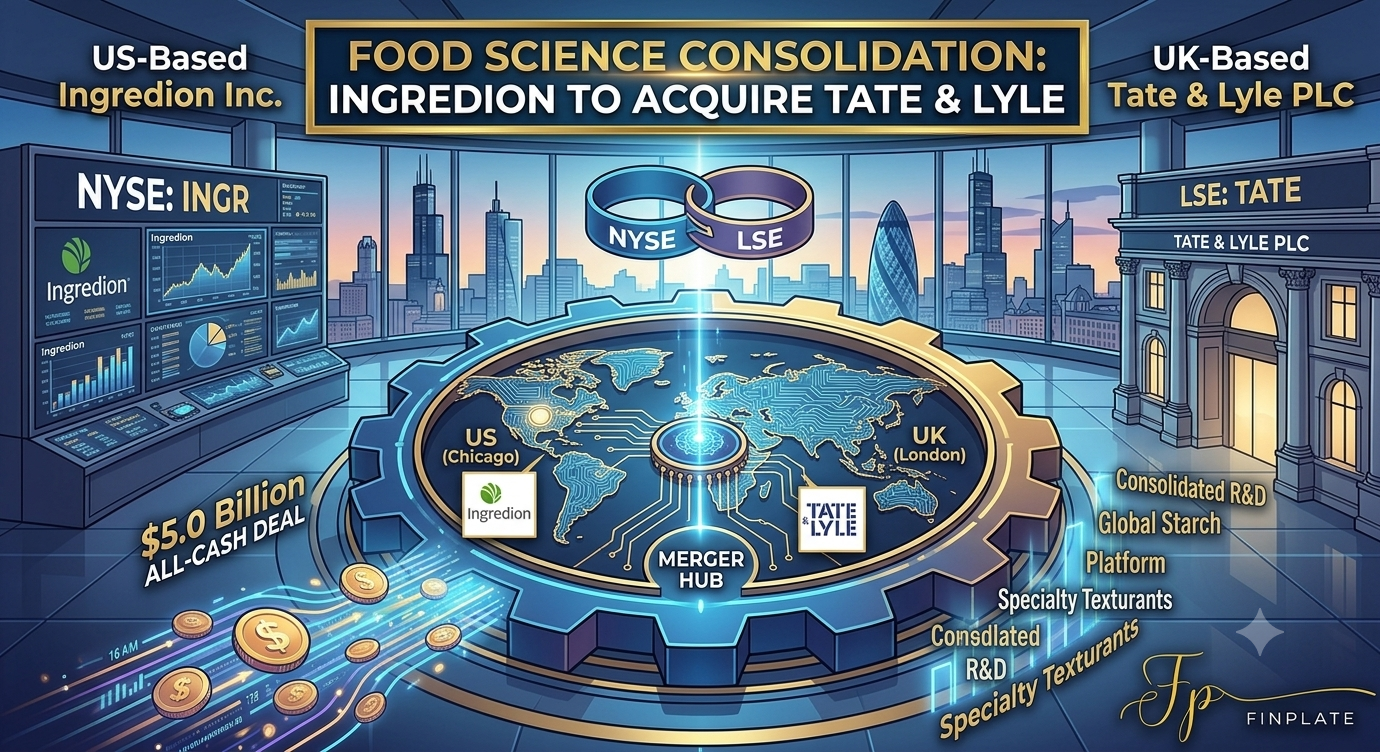
The global food and beverage supply chain is undergoing a massive capital realignment. In a blockbuster corporate move, Westchester, Illinois-based ingredient giant Ingredion Incorporated (NYSE: INGR) has announced a recommended all-cash offer to acquire London-listed food solutions pioneer Tate & Lyle PLC (LSE: TATE).
The transaction implies a total enterprise value of approximately £3.7 billion ($5.0 billion), calculated from the prevailing exchange rates ahead of the formal announcement. Under the terms of the agreed scheme of arrangement, Tate & Lyle shareholders are slated to receive 595 pence in cash per share. This cash consideration represents a substantial 58.7% premium over the company’s undisturbed closing share price on May 13, 2026.
Rather than a simple horizontal volume play, this multi-billion-dollar cross-border acquisition signals a critical macroeconomic shift: the complete consolidation of the highly technical “clean-label” and wellness-focused ingredient stack.
The Architecture of the Transaction & Capital Logistics
To execute this massive combination without straining near-term operational agility, Ingredion’s corporate treasury has structured a multi-tiered financing strategy. The acquisition will be funded via a mix of existing corporate cash reserves, newly issued debt financing, and a temporary bridge financing facility.
Financially, the balance sheet roadmap has been structured with clean deleveraging metrics:
- Pro Forma Leverage: Upon transaction closure, Ingredion projects its pro forma net leverage to sit at roughly 3.0x net debt-to-adjusted EBITDA.
- Deleveraging Timeline: Management has detailed a firm capital allocation pathway to organically reduce this metric down to a conservative 2.5x within 18 months post-completion.
- Synergy Targets: The boards have identified clear operational efficiencies, forecasting run-rate net cost synergies of approximately $130 million to be fully realized by the end of 2030, offset by estimated one-time integration costs of $175 million.
The deal has already passed its initial domestic boardroom hurdles, securing unanimous approval from Ingredion’s Board of Directors, while Tate & Lyle’s board has formally voiced its intent to recommend that shareholders vote heavily in favor of the scheme. Furthermore, institutional investor backing is already taking shape; Ingredion has secured an irrevocable undertaking from Huber Equity Corporation to vote its 16.8% stake in favor of the transaction.
Strategic Rationale: Unifying the Functional Ingredient Stack
For market analysts tracking consumer defensive sectors, the industrial logic behind this merger centers entirely on formulation capabilities. Modern food brands are battling shifting consumer sentiment and a demand for healthier portfolios, forcing a massive push toward sugar reduction, calorie containment, and advanced fortification.
By absorbing Tate & Lyle—which recently scaled its own texturant arm through a $1.8 billion acquisition of pectin and specialty gum leader CP Kelco—Ingredion is creating a definitive global provider of specialty ingredient solutions.
The merger unifies Ingredion’s massive core starch and texturant platform with Tate & Lyle’s proprietary scientific IP in mouthfeel, sweetening matrices, and dietary fiber enrichment. This unified R&D infrastructure allows the combined entity to offer end-to-end recipe development and multi-ingredient systems to global CPG clients, moving them away from simple single-commodity ingredient supplying.
Supply Chain Resiliency & Cross-Border Execution
Beyond the immediate laboratory and financial synergies, the geographic alignment addresses critical post-pandemic supply chain vulnerabilities. The merger natively bridges distinct international logistics networks. Combining Ingredion’s extensive footprint across the Americas with Tate & Lyle’s deeply entrenched networks in Europe, the Middle East, Africa, and Asia Pacific creates an extraordinarily robust, multi-jurisdictional supply framework.
This ensures that macro consumer clients can source stabilized, specialized ingredient solutions with much lower geographic concentration risk.
The transaction is currently targeted for completion in the second half of 2027, following standard shareholder votes, court approvals under the UK Companies Act, and antitrust clearances across multiple international trade zones. To monitor ongoing financial updates, proxy statements, or investor presentations directly from the source, capital allocators can review disclosures on the Ingredion Investor Relations hub.
Ultimately, this corporate combination proves that the future of the food tech economy belongs to scale. By consolidating scientific IP and global manufacturing footprints under one capital structure, the combined firm is positioned to dictate the flavor, texture, and nutritional profiles of consumer products for decades to come.
Want to decode the complex mechanics of global finance and central banking policy without the dry, confusing jargon? Stay ahead of the curve and explore more human-friendly financial deep dives at Finplate.co