

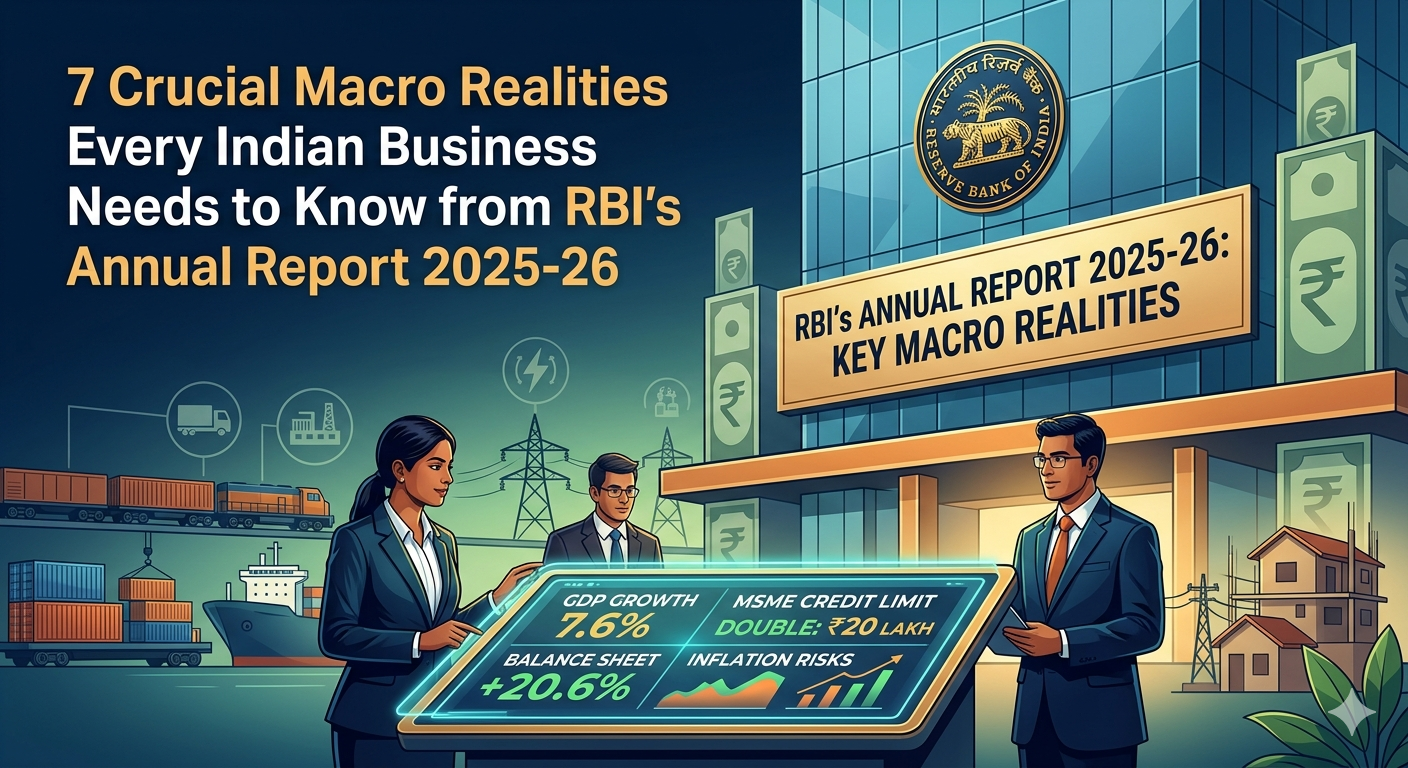

The release of the central bank’s major macro policy summary is always a defining moment for corporate planning, but the latest insights carry an entirely different level of weight. As global market shifts continue to challenge international trade corridors, the underlying fundamentals of the Indian economy are being rewritten. The data released within RBI’s annual report 2025-26 reveals an economic landscape that is both remarkably resilient and fiercely protective of its domestic stability.
A deep dive into the core findings of RBI’s annual report 2025-26 shows a central bank operating with an expanded balance sheet, aggressive credit deployment strategies, and a careful eye on external disruptions. For corporate finance professionals, founders, and investors looking to map out their next capital cycles, analyzing the data on the Reserve Bank of India Reports Portal provides an essential macro blueprint.
Let’s unpack the seven structural pillars shifting India’s commercial landscape over the next fiscal year.
1. The Balance Sheet Surge: Unpacking a 20.6% Asset Expansion
The most striking figure in the central bank’s financial disclosure is the staggering growth of its own balance sheet. According to RBI’s annual report 2025-26, the asset book expanded by a massive 20.6% year-on-year, climbing to ₹91.97 lakh crore compared to ₹76.25 lakh crore in the previous fiscal cycle. This brings the central bank’s balance sheet size to an absolute historic high, representing roughly 26.4% of India’s Gross Domestic Product.
This massive expansion wasn’t accidental. As documented in RBI’s annual report 2025-26, it was driven by sharp, strategic allocations on the asset side:
- Domestic Investments: Surged by an aggressive 44.9%.
- Gold Holdings: Climbed by a substantial 63.8% in absolute value.
- Foreign Investments: Maintained steady growth at 7.9%.
This deliberate asset pivot reflects a clear defensive strategy. The strategic data in RBI’s annual report 2025-26 shows that by leaning heavily into domestic assets and robust gold reserves, the central bank is building a massive cushion to absorb external economic shocks without destabilizing the local currency.
2. Guarding the Vault: The Multi-Billion Dollar Gold and Contingency Strategy
In a year defined by fluctuating global currency markets, the central bank’s approach to asset accumulation has sent a clear message to international finance. A key highlight within RBI’s annual report 2025-26 is that India’s total gold reserves have reached 880.52 metric tonnes.
While the actual volume added was a modest 0.94 metric tonnes over the year, the financial value of the gold held under the Banking Department jumped by an incredible 63.6%, rising to ₹7.06 lakh crore. This dramatic value increase was propelled by a combination of rising global gold prices and localized exchange rate adjustments against the US Dollar.
Simultaneously, risk mitigation remains a top priority. The surplus transfer details in RBI’s annual report 2025-26 state that the central bank transferred an overall surplus of ₹2.86 lakh crore for the year, representing a 6.7% increase over the previous period. Out of this, a prudent provision of ₹1.09 lakh crore was transferred straight into the Contingency Fund, ensuring that the country’s core monetary buffer remains intensely protected against sudden liquidity stresses.
3. The MSME Credit Revolution: A New ₹20 Lakh Safety Net
For small-scale enterprises and mid-market companies, the practical execution of monetary policy is shifting in a very tangible way. The sectoral credit chapters in RBI’s annual report 2025-26 note that non-food credit growth maintained an overall steady expansion rate of 15.9% as the fiscal year closed out. However, the real story lies in the intentional democratization of formal corporate credit.
To directly empower ground-level entrepreneurship, the collateral-free loan limit for micro and small enterprises has been officially doubled, moving from ₹10 lakh to a substantial ₹20 lakh. Coupled with a noticeable decline in the Weighted Average Lending Rate (WALR) on fresh rupee loans across key sectors, borrowing is becoming significantly less punitive.
This conscious systemic push aims to move mid-market enterprises away from informal, high-interest financing and integrate them deeply into formal banking channels.
4. Tracking the Multi-Speed Credit Momentum Across Key Sectors
The corporate credit markets are moving at multiple speeds, and understanding where the capital is flowing is vital for any corporate strategist. Industrial credit has maintained steady upward momentum, driven heavily by structural expansions in core infrastructure, basic metals, engineering, and chemicals.
Parallel to this, the services sector has maintained an unyielding double-digit expansion path. This momentum has been anchored by robust demand in commercial real estate, domestic trade, and a powerful recovery in credit extended to Non-Banking Financial Companies (NBFCs). By keeping the credit lines open to systemic NBFCs, the broader financial framework has successfully avoided the liquidity logjams that historically choked off secondary lending markets.
5. Navigating the Growth Paradox: The 7.6% Baseline vs. Future Headwinds
When looking purely at the headlines, India’s position as a global outperformer is undeniable. Clocking a real GDP growth rate of 7.6% for the financial year, the domestic economy has officially retained its status as the world’s fastest-growing large economy. This expansion was supercharged by steady private consumption growth and strong government capital expenditure on core infrastructure.
However, a careful analysis of RBI’s annual report 2025-26 reveals a distinct shift toward caution for the upcoming year. The real GDP growth projection for the next fiscal period is estimated at 6.9%. While a near-7% growth rate remains the envy of developed markets, the slight deceleration signals that the domestic economy is actively preparing for an increasingly volatile international trade environment.
6. The Inflation Rollercoaster: Easing Food Risks vs. Energy Wildcards
Domestically, the past year delivered massive structural relief to household budgets. Retail inflation saw a sharp, welcome contraction to around 2.1%, heavily insulated by a successful cooling of core food prices and adequate national foodgrain stocks.
Yet, the forward-looking models presented in RBI’s annual report 2025-26 suggest that this low-inflation environment will face distinct challenges. Projections for the coming year anticipate inflation adjusting upward to approximately 4.6%.
The primary culprits are external and highly unpredictable. Supply chain disruptions, volatile maritime shipping costs, and a structurally vulnerable global energy corridor mean that imported inflation remains a constant threat to domestic price stability.
7. Geopolitical Wildcards and the Shadow of Higher External Tariffs
The document makes it explicitly clear that domestic economic policy can no longer be formulated in isolation from global geopolitical realignments. Over the past year, the structural implementation of higher international trade tariffs and shifting supply chain alliances required rapid, tactical monetary interventions.
Looking ahead, the risk assessment section of RBI’s annual report 2025-26 flags the ongoing geopolitical friction in West Asia as the single most prominent downside risk to the domestic economic trajectory. If regional conflicts extend further into the year, the resulting pressure on global crude oil pipelines and international logistics networks will inevitably test India’s domestic buffers. Fortunately, with foreign currency assets and gold combining to form over 70% of the central bank’s total asset distribution, the defensive firewall is remarkably robust.
The Executive Takeaway for Finplate Readers
Ultimately, RBI’s annual report 2025-26 paints a picture of an economic superpower that is mature enough to recognize its vulnerabilities. India is growing rapidly, its commercial banks are exceptionally well-capitalized, and the corporate balance sheets are cleaner than they have been in a decade.
For businesses, the mandate is clear: capitalize on the easing credit frameworks and expanding domestic demand, but maintain a lean capital structure to handle the external inflationary pressures brewing across the border.

A Comprehensive Glance at RBI’s Annual Report 2025-26
| Macroeconomic Metric | Performance Status & Concrete Values | Strategic Economic Implications |
| Real GDP Growth Rate | 7.6% Actual Baseline | Confirms India’s position as the world’s fastest-growing major economy. |
| Total Balance Sheet Size | ₹91.97 Lakh Crore (20.6% YoY Expansion) | Dramatically increases the central bank’s structural capacity to absorb external market shocks. |
| Contingency Fund Transfer | ₹1.09 Lakh Crore Allocation | Deepens the national risk cushion to guard against sudden systemic liquidity shortages. |
| Domestic Asset Allocation | Scaled upward to 29.1% of Total Assets | Reflects an intentional defensive shift toward domestic market infrastructure. |
| Non-Food Credit Growth | 15.9% Absolute Expansion | Ensures that industrial, service, and infrastructure sectors remain strongly capitalized. |
| MSME Collateral-Free Limit | Doubled from ₹10 Lakh to ₹20 Lakh | Lowers structural entry barriers for small businesses seeking formal corporate credit. |
| Domestic Inflation Level | 2.1% Current (Projected at 4.6% for next year) | Signals temporary domestic relief but requires a cautious approach due to imported energy costs. |
Want to decode the complex mechanics of global finance and central banking policy without the dry, confusing jargon? Stay ahead of the curve and explore more human-friendly financial deep dives at Finplate.co