


The race for quantum supremacy is no longer confined to academic labs or speculative venture capital. It has officially entered the big leagues of public market consolidation.
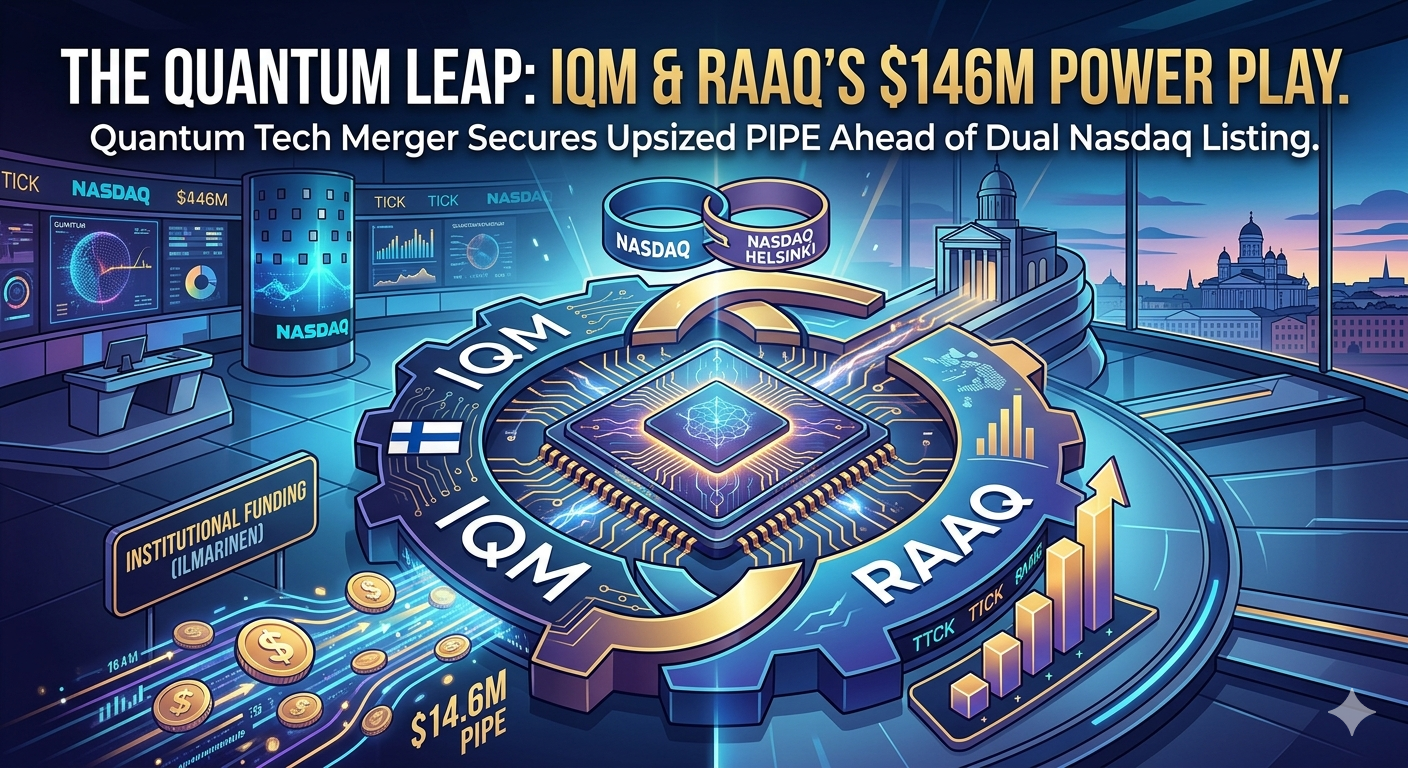
In a major advancement for advanced computing architectures, IQM Finland Oy (IQM) and its special purpose acquisition company (SPAC) partner, Real Asset Acquisition Corp. (NASDAQ: RAAQ), have announced a significant upgrade to their impending business combination. Bolstered by a fresh, heavy capital injection from institutional heavyweight Ilmarinen, the transaction’s Private Investment in Public Equity (PIPE) pool has officially been upsized to a staggering $146 million.
This,
quantum tech merger
isn’t just about a cash injection—it’s a calculated, structural move to lock down the foundational infrastructure of next-generation computing before the rest of the market catches up.
Breaking Down the Deal Mechanics
When a tech company merges with a SPAC, the market watches the PIPE pool closely. It serves as the ultimate validation from sophisticated institutional investors who are putting real skin in the game.
By upsizing the PIPE to $146 million, IQM and RAAQ are building an incredibly deep capital runway. Once the transaction formally closes, the newly formed entity is taking a highly ambitious path: a dual listing on both the Nasdaq Stock Market in New York and the Helsinki Stock Exchange.
Why a dual listing? It’s a brilliant capital play. It gives the company simultaneous access to deep-pocketed US tech investors and European institutional funds that prioritize local, high-growth sovereign tech infrastructure. In a sector where building specialized hardware requires relentless capital deployment, having two distinct public market taps to draw from is a massive competitive advantage.
Moving Beyond the “Quantum Hype”
Historically, quantum computing has faced skepticism from pragmatic market analysts. Critics call it a “tomorrow technology”—fascinating in theory, but years away from generating actual commercial cash flows or practical applications.
This transaction directly challenges that narrative. IQM isn’t just designing theoretical software; they are a vertically integrated powerhouse that operates its own dedicated silicon chip fabrication facilities, assembly lines, and quantum data center operations.
Bridging the “Fault-Tolerance” Gap
The biggest friction point in quantum computing today is error correction. Current systems suffer from environmental “noise” that corrupts calculations. The holy grail of the industry is fault-tolerant quantum computing—systems stable enough to run complex algorithms flawlessly without breaking down.
IQM is deploying this new $146 million capital pool explicitly to bridge this infrastructure gap. By scaling up their hardware manufacturing, they are positioning themselves as a primary utility provider for industries desperate for quantum power—from cryptography and molecular logistics to hyper-complex financial risk modeling.
The Big Picture: A Macro Tech Land Grab
The global market for advanced computing is undergoing a massive structural realignment. As traditional silicon chips hit their physical scaling limits and AI workloads demand exponential processing power, deep-tech infrastructure is becoming a core battleground for economic dominance.
While the broader retail market has spent the last two years hyper-focused exclusively on traditional AI data centers and graphics processing units (GPUs), sophisticated institutional capital is quietly skating to where the computing puck is going next.
By marrying RAAQ’s public market vehicle with IQM’s hardware intelligence, this transaction creates a highly liquid, publicly traded pure-play quantum stock. It provides a clean, modern blueprint for how deep-tech companies will fund heavy-duty infrastructure R&D moving forward.
To review the official Form F-4 registration statements, financial disclosures, and structural proxy terms detailing this business combination, check the latest disclosures directly on the U.S. Securities and Exchange Commission (SEC) database.
Want to decode the complex mechanics of global finance and central banking policy without the dry, confusing jargon? Stay ahead of the curve and explore more human-friendly financial deep dives at Finplate.co